
Table of Contents
- Quick answer: what changes when the back office is automated
- The example project we're following
- Stage 1: Collecting project and homeowner info
- Stage 2: Plan set QC and diagrams
- Stage 3: Permit research and tracking
- Stage 4: Utility and interconnection paperwork
- Stage 5: Revisions, BOM and financier milestones
- How Wattsun handles one project, step by step
- Common mistakes when starting with solar operations automation
- Takeaway
- FAQ
One residential job passes through a lot of hands before PTO. Homeowner details come in half done. The plan set needs a QC pass. Someone looks up permit rules for the address, someone else fills the utility forms, and then everybody checks status. Solar operations automation changes who does the repetitive first pass on each of those steps. It doesn't change who signs off. Below, we follow one project through both versions, stage by stage, so you can see where the work moves and where it stays with your team.
Quick answer: what changes when the back office is automated
In a manual back office, your team gathers, checks, fills and chases every document; with solar operations automation, AI agents do that first pass, and your team approves the results. The project stages stay the same. What changes is who does the repetitive work, how problems get flagged, and that nothing goes out until a person approves it. Rules still vary by AHJ, utility and state, so final review stays with you.
The example project we're following
Say a residential rooftop job with a battery just closed. Sales hands it to ops with a signed contract, a site survey, install-site photos and a CRM record missing a few fields. Your team works out of shared file storage, email, team chat and spreadsheets. Same job, same people, same AHJ in both versions. Only the back office changes.
Stage 1: Collecting project and homeowner info
The difference here is when you find out something is missing.
- Manual: Someone compares the CRM record, the survey and the photos by eye. A missing utility account number or an unreadable panel label often shows up later, when a form needs it.
- With automation: Wattsun by Solar Agent Hub audits the record for missing homeowner info and reviews the site survey and photos. You get back a list of what's missing or unclear.
- Still yours: Calling the homeowner, or sending someone back to the site.
Stage 2: Plan set QC and diagrams
Plan set QC moves from a line-by-line read to reviewing a list of flagged issues.
- Manual: A trained reviewer works through the set against your checklist. Per the Solar Agent Hub site, a manual plan-set QC takes 45 to 60 trained minutes. Your design team draws the single-line and three-line diagrams.
- With automation: Wattsun checks the plan set against your company's own checklist and returns each issue with its sheet and the code it breaks. It can also draw the single-line and three-line diagrams.
- Still yours: Your design lead decides which issues are real, how to fix them, and when the set is ready.
Stage 3: Permit research and tracking
Permit work shifts from looking things up and chasing status to acting on what gets found and flagged.
- Manual: Someone researches the AHJ's requirements for the address, builds the packet, logs the submittal in a spreadsheet and checks status when they remember.
- With automation: Wattsun researches the permit rules for the address and flags any permit stalled more than 7 days.
- Still yours: Confirming anything unusual with the AHJ, and approving any submission. Nothing is uploaded or submitted until a person approves it.
Stage 4: Utility and interconnection paperwork
Utility forms go from retyping to reviewing.
- Manual: Someone copies system details, homeowner info and equipment specs into the utility's forms, attaches the diagram, double-checks and sends.
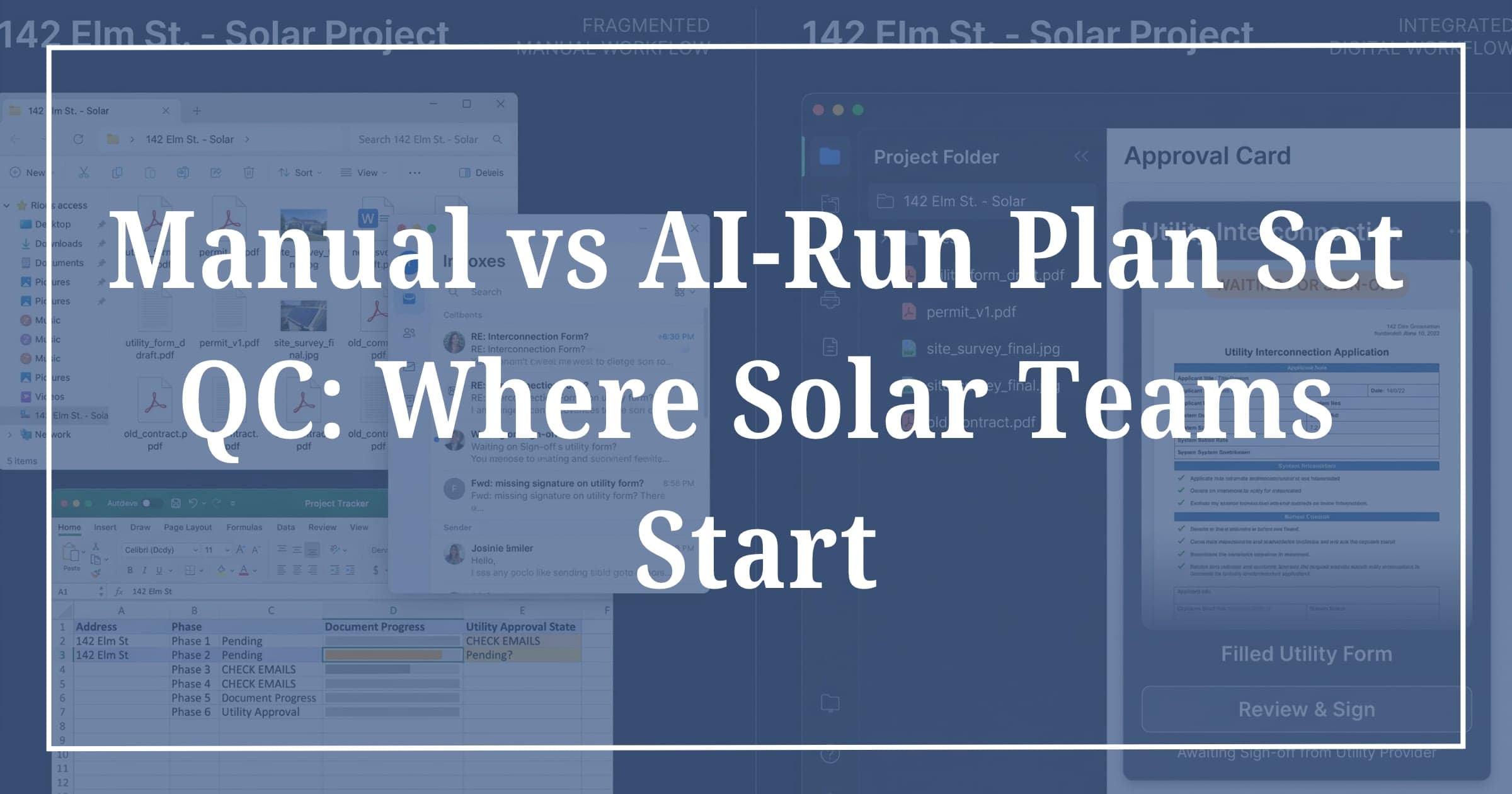
- With automation: Wattsun fills the utility and interconnection paperwork. An approval card shows exactly what will be sent before anything goes out. If two files could fit, say two versions of the three-line, Wattsun stops and asks which one.
- Still yours: Reading the card, then approving or fixing.
Stage 5: Revisions, BOM and financier milestones
Late-stage work is where projects quietly stall, and automation moves the gap-finding earlier.
- Manual: Revision comments arrive by email and get routed by hand. Someone checks the BOM against stock. Financier milestone packs get built at the end, and a missing document sends someone digging.
- With automation: Wattsun pulls the BOM from approved plans and compares it with inventory, builds financier milestone packs and finds missing financier documents. [FACT NEEDED: whether and how Wattsun handles AHJ or utility revision comments]
- Still yours: Deciding how to answer a revision, ordering parts and releasing anything to the financier.
How Wattsun handles one project, step by step
Wattsun is one coordinator: you ask in plain language, and it hands the job to the right specialist or brings in more than one.
- You ask. For example: "QC the Oak Street plan set against our checklist and tell me what the financier pack is missing."
- You see the cost. It shows before the run starts.
- It works where your files live. File storage, email, team chat, spreadsheets and CRM, through sign-in access. No new dashboard.
- It uses your rules. SOPs and checklists you upload once sit in company memory. Correct something once and it applies to every job.
- It returns results or a question. Issue lists, filled forms and flags. If more than one file or answer could fit, it asks.
- You approve. Anything to be sent, uploaded or submitted waits on an approval card. Every run records who ran it, what changed and who approved.
- Repeat jobs run on a schedule. A job you ran can become a schedule or a trigger, and jobs can run overnight.
Common mistakes when starting with solar operations automation
Most early problems trace back to setup habits.
- A vague checklist. Wattsun reviews against your checklist, so gaps in the checklist become gaps in the review.
- Clicking through approval cards. The card is your check. Read it.
- Carrying one AHJ's rules to the next. Requirements vary by AHJ, utility and state.
- Starting with everything. Pick the stage your team redoes most, correct the rules a few times, then add the next.
Takeaway
The project stages are the same in both versions. In a manual back office, your team does every first pass by hand. With solar operations automation, Wattsun does the gathering, checking, filling and flagging, and every output waits for someone on your team to approve it. Start with the stage your people redo most, and write that checklist down first.
To see this run on one of your own projects, book a demo.
FAQ
Which back-office task should a solar company automate first?
Start with the task your team repeats on every project, that follows a written checklist, and that produces a clear list of issues to act on. For most installers and EPCs, that's plan set QC against your own checklist, stalled permit flags or missing-document checks. Once the first task is running well, add the next one.
How do you know if a back-office task is ready to automate?
Run the task through four tests. Does it happen on every project? Is there a written rule behind it? Is the result a clear list? Does the job sit in a queue waiting for someone? A task with four yeses is a strong first pick. Tasks that need a fresh judgment call every time fit better a little later.
How does AI automation change plan set QC?
A manual plan set QC means a trained reviewer works through every sheet against the checklist, which takes 45 to 60 minutes per set. With Wattsun, the set is checked against your checklist, and each issue comes back with its sheet and the code it breaks. Your design lead starts from a finished list instead of a blank search.
When should you automate utility paperwork and permit research?
Add them once your first task is running and your checklists and SOPs are well tuned. This group also includes single-line and three-line diagrams and site survey and install photo review. Rules vary by AHJ, utility and state, so these tasks work best after your team has seen how Wattsun reads your rules.
What are the most common mistakes when starting with AI automation?
The common ones are starting five tasks at once, automating a checklist nobody agrees on, not noting how long the task takes today, and fixing the same miss over and over. Go one task at a time, settle the checklist with its owner first, and when a correction keeps coming up, update the checklist itself.
Does Wattsun send or submit anything without approval?
No. Anything that needs to be sent, uploaded or submitted waits for a person to approve it on an approval card that shows exactly what will happen. If more than one file could fit, Wattsun stops and asks. Every run leaves a record of who ran it, what changed and who approved.